


What They Take: Foyson and Cattle Mutilations

In the last three installments of this series, I have been building a case. I started with the foyson itself, that old Scots word for the essence or goodness of food, the quality that Robert Kirk described in 1691 as the substance that faerie peoples extract from offerings while leaving the physical matter behind. I moved into the biochemistry of freshness, showing that foyson has a measurable analog in the biogenic amines that accumulate as food ages, degrading precisely the kind of nutritional richness that the folklore says the nonhuman peoples seek. Then, in "The Sacred Cow," I laid out the evidence that the cow produces more usable, more varied, more stable, and more abundant foyson than any other animal on earth, across her milk, her meat, and her butter, and that every civilization that figured this out made her sacred.
Now comes the question I promised you at the end of that piece. If the cow is the richest source of fresh foyson available to both the human and the nonhuman world, what happens when something needs that foyson badly enough to take it directly from the source?
I think the answer has been lying in fields across five continents for over four hundred years, and I think we have been looking at it the entire time without understanding what we were seeing.
Before I walk you through the history, I need to describe what we are talking about, because "cattle mutilation" is a phrase that conjures very different images depending on where you first encountered it. The tabloid version is sensational and vague. The documented version is clinical, specific, and consistent across hundreds of years of records.
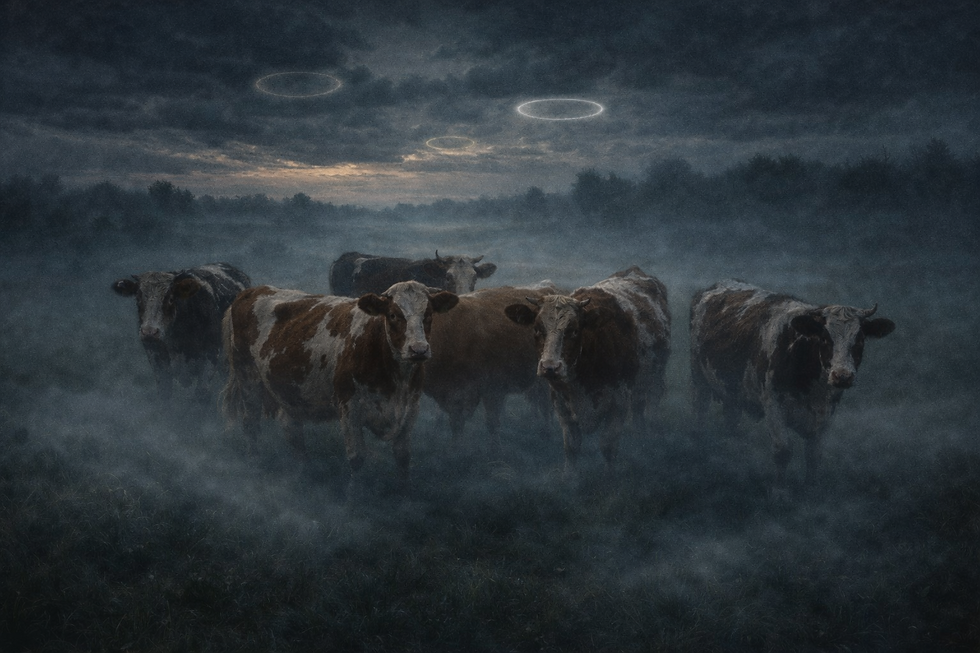
In a typical mutilation case, the animal, almost always a cow or a bull though horses, sheep, goats, and even wild deer and elk have been found in the same condition, is discovered dead in a field or pasture with a specific set of characteristics that repeat across cases, across decades, and across continents. The blood is gone entirely, as though it had been drawn out of the animal by a process that left the ground dry and the tissues empty. Soft tissue organs have been removed with what witnesses, veterinarians, and law enforcement officers have repeatedly described as surgical precision. The organs most commonly taken are the reproductive organs, the tongue, the eyes, the ears, the jaw flesh, the lymph nodes, and the rectum. The incisions are clean, sometimes described as cauterized, with edges that appear to have been cut by something far more precise than any blade a predator carries.
Every track is absent from the area around the body, including the animal's own hoofprints, as though it had been placed there from above. Scavengers avoid the carcass entirely. Coyotes, vultures, insects that would ordinarily begin feeding within hours of a death in open pasture stay away. In some cases, the avoidance persists for days or weeks, with the carcass decaying far more slowly than expected in the open air. In some cases, Geiger counters brought to the scene have registered radiation levels that have no natural explanation in a cattle pasture.
This is a pattern documented across thousands of cases spanning more than four centuries.
The earliest known documented outbreak of unexplained livestock deaths appears in the official records of the Court of James I of England, dated February 10, 1606. The entry reads, in modernized language, that about the city of London and some of the shires adjoining, whole slaughters of sheep had been made, in some places to the number of a hundred, in others less, where nothing was taken from the sheep but their tallow and some inward parts, the whole carcasses and fleece remaining still behind. The record notes that there were sundry conjectures but most agreed that it tended towards some fireworks, a phrase that in early seventeenth-century English meant something incendiary or unexplained rather than celebratory.
I think the details in this record are worth dwelling on. A hundred sheep at a time, killed, with only the tallow and internal organs removed, the rest of the animal left untouched. The scale alone rules out any known predator, and the selectivity, taking only internal fat and organs while leaving the meat and wool, rules out any butcher of that era who would have valued precisely the parts that were left behind. The court of James I recorded it because they had no explanation for it either.
Charles Fort, the American writer who spent his career collecting accounts of phenomena that conventional science had overlooked, gathered additional reports of unexplained livestock deaths from England throughout the late nineteenth and early twentieth centuries. The pattern was already old by the time anyone in the modern era began to notice it.
The case that brought cattle mutilation into the modern public consciousness happened in Alamosa County, Colorado, in September of 1967. A three-year-old Appaloosa mare named Lady, who was later misidentified by the press as Snippy (actually the name of Lady's sire, though the wrong name stuck permanently), was found dead about a quarter mile from the Harry King Ranch. Lady's head and neck had been completely skinned and defleshed, leaving only bleached-looking bone. The cuts were described by witnesses as smooth and precise, and Harry King, who had been around animals his entire life, said the precision was beyond anything a coyote or pack of predators could produce. The scene was entirely bloodless, the body drained, the ground dry. A strong chemical odor, described as medicinal and sickly-sweet, hung in the air around the carcass.
Lady's own tracks ended about a hundred feet from where her body lay, as though she had been carried or set down from that point forward. Within the trackless radius, several small holes were found punched into the ground in a pattern, and two bushes were completely flattened. A United States Forest Service ranger named Duane Martin checked the area with a Geiger counter and registered unusually high radioactivity for several hundred yards around the body, in a location where elevated readings had no natural explanation. Mrs. Lewis, who handled a piece of the horse's flesh, reported that her hand burned and turned red until it was washed.
The Condon Committee, a University of Colorado team funded by the Air Force to study UFO reports, investigated and concluded there was no evidence of abnormal causes. A local veterinarian later discovered what appeared to be two small-caliber bullet wounds in the horse's rump, and two students from Alamosa State College eventually confessed to shooting at the horse weeks after the story broke. The bullet wounds could explain a death, but the defleshing, the bloodlessness, the chemical odor, the radiation, the vanished tracks, and the flattened bushes remain unexplained by any conventional account. Lady's case remains open in the minds of everyone who has looked at the full evidence rather than the convenient partial version.
After Lady, the dam broke.
Throughout the 1970s, reports of cattle mutilations surged across the American West and Midwest, with the heaviest concentrations in Colorado, Kansas, Nebraska, and New Mexico. By 1975, Colorado alone had documented nearly two hundred cases. The pattern was consistent and, to the ranchers and law enforcement officers dealing with it, beyond any available explanation. Animals found bloodless, organs surgically removed, tracks entirely absent, scavenger activity absent, and in some cases, clamp marks on the animals' legs suggesting they had been lifted and held somewhere before being returned to the field.
The FBI investigated from 1974 to 1978, and in January 1980 closed its inquiry with the official position that the reported cases appeared to involve mutilations by common predators. Ranchers who had been examining livestock their entire lives sharply disagreed. Sheriff George Yarnell of Elbert County, Colorado, told the New York Times in 1975 that he had been around cattle all his life and could certainly tell whether a death had been caused by a coyote or a sharp instrument.
Linda Moulton Howe, a Stanford-educated journalist who had already won Regional Emmy Awards for environmental documentaries, began investigating the mutilations in 1979. Her 1980 documentary A Strange Harvest, which aired on the Denver CBS affiliate to the largest audience in the station's history for a locally produced program, laid out the field evidence meticulously and earned her another Regional Emmy. Her subsequent book, An Alien Harvest, compiled decades of case documentation, rancher testimony, and law enforcement statements. Howe concluded that the perpetrators were extraterrestrial beings harvesting bovine biological material for survival or research purposes, a conclusion that I respect for its courage, though I read the evidence differently, for reasons I will get to shortly.
What matters for the foyson argument is her data. Her field documentation of the physical characteristics, the surgical precision, the complete exsanguination, the selective organ removal, the scavenger avoidance, and the absence of tracks, has been referenced by virtually every subsequent researcher in this space. The cases she documented are real. The pattern is real. The question is what the pattern means.
In the summer of 2019, five purebred bulls were found dead on the Silvies Valley Ranch in Harney County, eastern Oregon, one of the most remote and sparsely populated regions in the lower forty-eight states. Each bull exhibited the same characteristics that had been documented since the 1970s, incisions on soft tissues including eyelids, ears, and reproductive organs, made with apparent surgical precision, complete absence of blood, tracks entirely absent from the surrounding ground, and zero predator or scavenger activity despite the carcasses lying in open rangeland where vultures and coyotes operate freely.
The ranch's vice president, Colby Marshall, told NPR that there was not a single drop of blood on the ground or on the animals. Local authorities investigated and could determine neither a cause of death nor a perpetrator. The precision of the cuts and the total absence of forensic trace made conventional explanations difficult to maintain for anyone who stood over those bulls and looked at what had been done.
Oregon emerged as a new hotspot through the late 2010s and into the 2020s, with twenty-one cases reported over six years in the state. Local authorities increased patrols in rural areas but made no arrests and offered no definitive explanations. The cases became the subject of a 2025 documentary titled Not One Drop of Blood, which centered on rancher accounts from the region and the investigative dead ends that have followed every wave since the 1970s.
The estimated total of cattle mutilated under these circumstances since modern record-keeping began is approximately ten thousand animals. The phenomenon has been documented in every state in the US, every province in Canada, across South America with an estimated thirty-five hundred cases since 2002, and in parts of Europe, Australia, and the UK. It is global. It is ancient. It is ongoing.
I have spent three blog posts establishing that the cow is the single greatest source of fresh foyson on earth, and that the organs with the richest blood supply, the densest concentration of bioactive compounds, and the most rapid spoilage rates are precisely the organs that carry the most foyson at the moment of death. What follows is my hypothesis, built on the evidence I have presented across this series.
The organs consistently removed from mutilated cattle are the reproductive organs, the tongue, the eyes, the lymph nodes, and the rectum. The reproductive organs are among the most blood-rich, hormone-dense tissues in any mammalian body. The tongue is heavily vascularized muscle with direct blood supply from the lingual artery. The eyes are connected to the brain by the optic nerve and supplied by the ophthalmic artery. The lymph nodes are the body's immune filtration centers, packed with white blood cells, antibodies, and biological information about the animal's health. The rectum connects to the lower digestive tract and its blood supply. Every one of these organs is, at the moment of death, saturated with the freshest, most biologically active material the animal contains.
The blood is taken entirely. All of it. In a thousand-pound cow, that is approximately ten gallons of blood, removed without spillage, without pooling, without staining the ground. Blood is the body's transport system for everything, oxygen, nutrients, hormones, immune factors, minerals, all carried in blood. If foyson is the essence of biological material, the usable life-quality that a body can absorb and be nourished by, then blood is the single most foyson-dense fluid in any living animal, and a cow's blood is the most foyson-dense blood available from any common livestock species, given everything I have shown about the cow's nutritional superiority across milk, meat, and butter.
I think what the mutilation data shows, when you read it through the foyson framework, is extraction. Targeted, precise extraction of the specific biological materials that carry the highest concentration of fresh foyson, performed by something that knows exactly what it is taking and why.
Introducing.. “faeliens”. I can't take credit for this term, though.
Here is where I part company with the extraterrestrial hypothesis.
I believe the beings responsible for cattle mutilations are the same beings that Robert Kirk documented in 1691, the same beings that the Irish left cream and butter for on their doorsteps, the same beings that stole nursing mothers to feed their young, the same beings that the folklore of every culture on earth has described living alongside and feeding from human and animal life for as long as stories have been told. I believe they are interdimensional, and that the distinction from extraterrestrial matters enormously because it changes what the mutilations mean.
Under the alien-research hypothesis, the mutilations are scientific sampling, cold and clinical and detached. Under the interdimensional hypothesis, under the foyson framework, the mutilations are something much simpler and much older. They are feeding. They are doing at the scale of the whole animal what Kirk described them doing to a bowl of cream left on the threshold, extracting the foyson, the essence, the biological vitality, and leaving behind a husk that looks like a body but carries none of its life.
I sometimes call them faeliens, half-joking, because I think the line between "alien" and "faerie" has always been drawn by people who could accept one word but refused the other, when both might describe the same peoples encountered in different centuries, interpreted through different cultural lenses. The beings Kirk met on Doon Hill and the beings that ranchers in Oregon are dealing with today may occupy the same category under different names.
The scavenger avoidance is the detail that seals it, I think. Coyotes, vultures, and insects will refuse to touch a mutilated carcass. Katharine Briggs documented that animals refused to eat food from which the faeries had taken the foyson. Evans-Wentz recorded the same thing. Campbell, Kirk, Daimler, all of them noted that once the essence had been extracted, what remained was unfit even for animals. I suspect the scavengers are responding to the same absence, the foyson is gone, and what remains is a husk that nothing in nature recognizes as food anymore.
Most writers in this space frame cattle mutilation as an atrocity committed by something monstrous. I think the framing itself is the problem.
Humans farm cattle. They breed them, confine them, transport them, and slaughter them by the hundreds of millions every year. They drain the blood. They remove the organs. They process the bodies into products on an industrial scale that dwarfs anything the mutilation phenomenon represents by orders of magnitude. In the United States alone, approximately 33 million cattle are slaughtered commercially every year. The mutilation count, across all countries, across all decades, is estimated at around ten thousand total.
Anyone calling the nonhuman peoples monsters for taking what they need from cattle owes themselves a look at what the human species does to those same animals, at those numbers, every single day. Humans drain blood. Humans take organs. Humans do it to feed themselves and to survive, and they do it at a scale that makes the mutilation phenomenon look like a rounding error. The moral outrage humans reserve for the mutilations is strikingly absent from the conversation about the slaughterhouse, and I think the inconsistency tells us more about the species reacting than about the beings they are reacting to.
The nonhuman peoples who extract foyson from cattle are feeding. A farmer who milks a cow is feeding. A rancher who slaughters a steer for market is feeding. The method is different, the scale is different, the biology of the feeder is different, but the fundamental act, taking what you need from another living thing to sustain your own life, is exactly the same thing that every organism on this planet does every single day.
What I do think is worth asking, and what this series is building toward, is why they need it so badly, and why the need appears to be growing. The Selena Moor testimony, collected in Cornwall in the 1870s, tells us that the faerie children were not so strongly made as they used to be, for want of more beef and good malt liquor. If that was true in the nineteenth century, I have to wonder what the state of things looks like now, in a world of processed food, industrial dairy, fluorescent lighting, and vanishing darkness, a world where the foyson available in the human food chain has been declining for generations.
I suspect the mutilations are deliberate. I suspect they are desperate- the ones not committed by humans and human government, anyways.
In the next installment of this series, we are going to talk about blood as the ultimate carrier of biological essence, the fluid that every feeding tradition and every blood-centered folklore has fixated on since the earliest records. There are historical, medical, and folkloric threads that converge on blood in ways that connect directly to everything I have presented so far.
I suspect you already know what some of those threads are. Stay tuned.


Comments