


The Darling Month of May


The cattle came up between the two fires at evening, and the druids who had built the fires spoke over them as they came, and the year reorganized itself around the agreement that the herd was now under the protection of whatever had been spoken over the heat between the flames. This is the picture Sanas Cormaic, the Irish glossary attributed to Cormac mac Cuilennáin and dated to roughly the early tenth century, gives of May 1, where the entry for Belltaine derives the name from bil-tene, lucky fire, and describes druids lighting two fires "with great incantations" and driving the cattle between them. Roughly a thousand years on, in the nineteenth century, the practice was still being recorded across parts of Ireland and Scotland, almost unaltered. May 1 was the day the herd moved, and the fires were lit, and something in the landscape was being addressed.
I'm Tillie Treadwell, the How I Met Your Monster columnist for Eerie Expeditions Magazine, and the entry you are reading is a thinking-out-loud about what the older households were actually doing on May 1, in their kitchens and on their doorsteps and at the corners of their fields, and what I think the shape of those practices reveals about the kind of relationship May was understood to renew. May, in my reading of the folkloric record, was a truce window. The truce in question was the public renewal of a continuous arrangement the household had been keeping all year. I think what the modern world has held onto is the renewal date. I think what the modern world has lost track of is the rest of the contract, and I think Themselves, as the older Irish households so carefully called them, have not lost track of any of it.
A protective ritual presupposes a force the protection is aimed at. The druids who lit Cormac's fires and walked the cattle between them were addressing populations the household understood to be present in the field already, populations with a longer claim on that ground than the cattle had, who were there before the herd arrived and would still be there long after the cattle were brought home for autumn. A polite announcement was what the fires made. Cattle entered the warm months under a renewed agreement. What lived in the field was being asked, in the most public language the year permitted, to honor that agreement. Folk record across Ireland and Scotland and the Isle of Man, the three regions where Beltane was most widely observed, treats the fire ritual as the centerpiece of a festival whose other practices, taken together, look very much like the practices of a household preparing for a guest it intends to treat well.
What the household did at the threshold tells the same story in smaller letters. Lady Wilde, who collected from the West of Ireland and published Ancient Legends, Mystic Charms, and Superstitions of Ireland in 1888, recorded the practice at the door directly. Primroses had to be scattered before sunrise on May Day, and only primroses plucked before sunrise carried the protection, because "the evil spirits cannot touch anything guarded by these flowers, if they are plucked before sunrise, not else." The same record adds that "branches of whitethorn and mountain ash are wreathed round the doorway for luck." A coal was placed under the churn and another under the cradle. The shape of the account, taken whole, is the shape of a household decorating the threshold for the day a particular kind of company was understood to be moving across the country, with hawthorn flowers above the door and yellow wildflowers at the step, and the gestures themselves carrying a register the modern reader will recognize from any house preparing for an arrival. This was, in my reading, the language of welcome with the careful boundaries welcome always carries when the guest is known to be powerful.
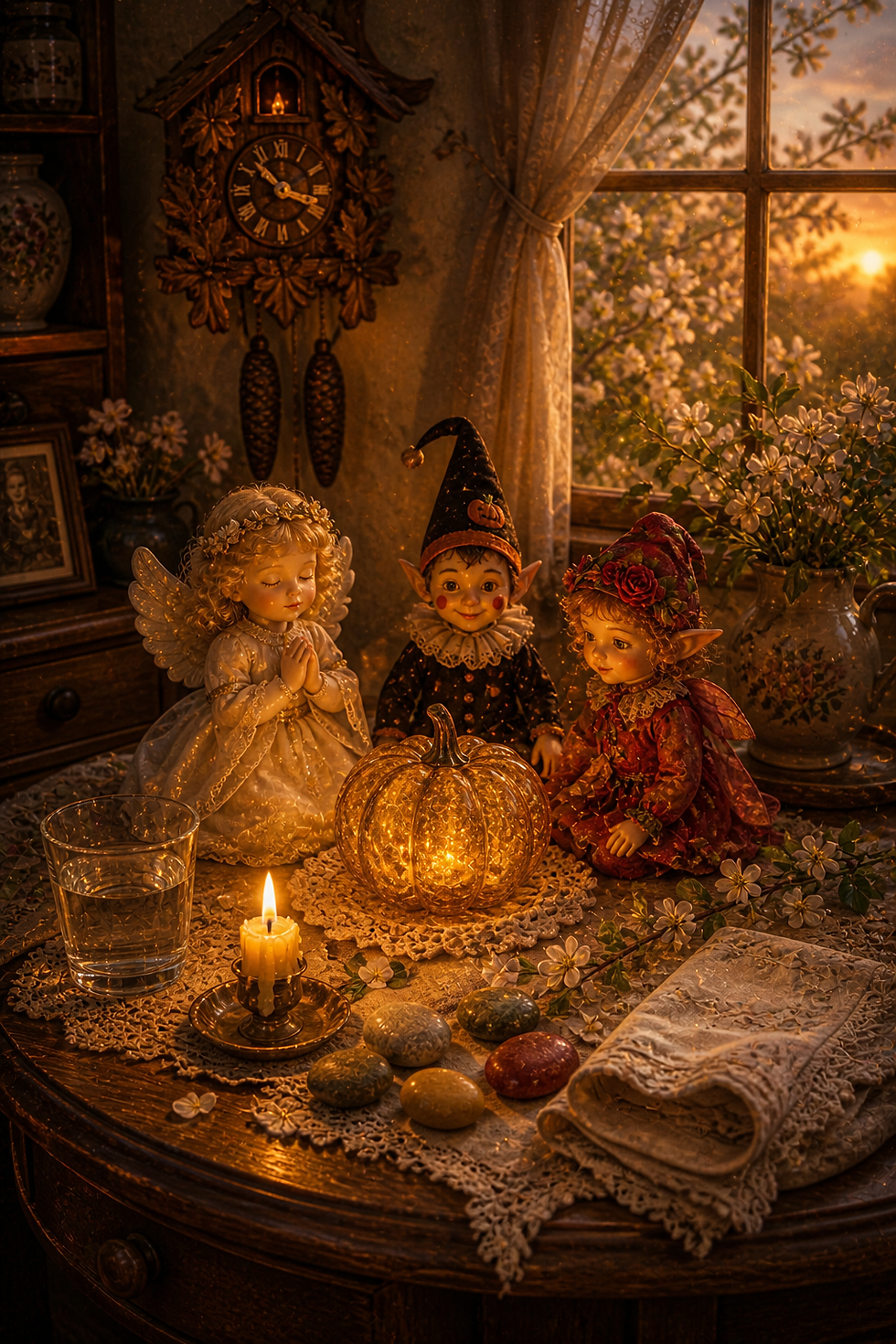
A particular form of the same gesture lived all across Ireland in the May Bush. Households on May Eve set up a flowering branch of hawthorn, the whitethorn of the field, planted in front of the house or tied to the front fence, and decorated the bush with wild flowers, ribbons, sea shells, and colored eggshells in the colors the household had on hand. Candles were lit beside it in the evening when candles were affordable. The bush stayed at the front of the house through the night and into the morning, and what it marked, in the older sense, was that the household had set a place at the field's edge for the people whose tree the hawthorn had always been understood to be. An offering and an acknowledgment, the May Bush carried both functions in its single small ceremony at the front of the house. Whose blossom it was, the household had not forgotten, and that blossom was being set at the threshold for one night and one morning specifically, with the implicit understanding that the rest of the year the tree itself would be left where it stood.
Hawthorn ran with this language consistently across the British folkloric record. A lone hawthorn standing in a Highland field or an Irish landscape was held as a faerie tree, and harming one was held to bring the wrath of the people who lived in it. Households worked their fields around the tree. Roads diverted, plows lifted, builders refused. Bringing the blossom indoors at any other time of the year was understood to invite the bad luck of having brought a population indoors that did not wish to be indoors. May Day was the named exception. The blossom was permitted to come into the house on May 1 because, in the older arrangement, what lived in the hawthorn was on that day willing to come into the house with it. I think that one detail- the year-round prohibition lifting on a single named day, the willingness of one population to accept the threshold-crossing on the day the other population had publicly invited them- is the most precise document of mutual consent in the whole British folkloric record.
The Welsh tradition kept the same shape under different vocabulary. May Eve, called Nos Galan Mai or Nos Galan Haf, was one of three Ysbrydnos, the spirit nights, alongside St John's Eve and Halloween. The boundary between worlds was understood as especially thin on the Ysbrydnos, and Calan Mai itself was kept with bonfires and with hawthorn branches- draenen wen, the whitethorn- gathered to decorate the outside of houses. Lady Gregory, collecting from the West of Ireland a generation after Lady Wilde and publishing Visions and Beliefs in 1920, recorded the sídhe themselves moving in May, riding "on horses through the night-time in large companies and troops, or ride in coaches, laughing and decked with flowers and fine clothes." Her informants told her that "always on the first of May" the foyson, the essence of the butter, "used to be taken." May was the month they rode visibly. May was the month the household kept the door decorated and the salt and the fire close, because May was the month a population usually heard but not seen had agreed, in the older arrangement, to be a population that could be addressed in the open.
A festival sits inside a year. What the household had been doing every other day of that year is the part of the older arrangement most modern observers have stopped tracking. Reginald Scot, writing from England in 1584 in The Discoverie of Witchcraft, described the English Robin Goodfellow as a household helper who "would supplie the office of servants, speciallie of maids," making the fire in the morning, sweeping the house, grinding mustard and malt, and drawing water, in exchange for "a messe of white bread and milke" set out for him every night. Every night, the entry specifies, was the exchange. In the Scottish Highlands and the islands, milk was poured on holed stones called the leac gruagaich for the gruagach and the glaistig, often after every milking, and Carmichael's Carmina Gadelica records these stones across what amounts to the entire Gàidhealtachd- Arran, Kintyre, Gigha, Islay, Mull, the Uists, St Kilda, Lewis, Sutherland. On the Isle of Man, bakers stuck a piece of dough to the kitchen wall at every baking for the mooinjer veggey who would, in exchange, help the bread to rise. As recently as the 1950s, on at least one Dartmoor farm, milk was still being put out overnight for the pixies.
What runs through every one of these practices is the rhythm of a working year, not a festival day. A bowl refilled on Robin Goodfellow's hearth at dusk on a Tuesday in October. Dough went up on the Manx wall whenever bread was rising. Highland milk poured into a leac gruagaich after every milking through the year, and a Dartmoor windowsill saucer went out on a Wednesday in February as readily as on May Eve. May 1 was the day the relationship was visible to a wider audience. The relationship itself was every day.
What the festival did, in the older arrangement, was renew an agreement the household had been keeping the rest of the time. May 1 was the public day of an arrangement the household had been honoring on the small private register every evening, every milking, every loaf, every threshold crossing of a working year. The hawthorn taboo lifted on May 1 because the year-round practice had earned the lifting. The household had been treating the tree with deference for the previous twelve months, and the day the blossom came indoors was a day that fell at the end of that twelve-month deference, not at the beginning of a single-day deference that would close again at sunset.
What I think Themselves have been waiting for ever since the rest of the contract started thinning away, in my reading of the cases I have walked and the literature I have read, is for the household to remember that the May Bush at the front fence was the small visible piece of a much fuller relationship. They have not forgotten the relationship. They have been the ones keeping their end of it, in the patient slow way they keep most things, while the human side of the agreement reduced itself across the centuries from a year-round attention to a single annual kindness, and from a single annual kindness to a half-remembered phrase on a festival calendar.
Where I am writing from belongs in this account, because the reading I am offering is interpretive and the interpretation matters. I have been in contact with nonhuman peoples my entire life. The relationship has been continuous since before I could speak, and the casework I have done over the decades since has been worked in conversation with that continuous relationship rather than at any distance from it. What the older Irish and Scottish records describe is a population I recognize, and the practices the records describe are practices I recognize as the kind of attention this population responds to. I think the resentment the modern world has earned, by collapsing the relationship into a one-day festival the calendar can hold without effort, is real. The shape of it is closer to the slow withdrawal of a friend who has decided to stop dropping by because the household has stopped opening the kitchen door for company that arrives without an invitation, the friend still alive and still nearby, simply no longer in the habit of stopping in.
Beltane in 2026 falls on a Friday, with the Saturday after it bringing the first weekend of the renewal window and the long bright slow gold pause of an early May evening at the end of the month's first work week. Most of the hills where the fires used to be lit have gone dark, the cattle no longer walk between flames in any field I am aware of in this country, and most of the May Bushes on the British and Irish countryside came down decades ago and have not been replaced. I do think the renewal is being attempted in smaller forms in households across the calendar this evening, by people who would not necessarily know to call what they are doing by the name the older households used, and who are reaching for a candle or pouring a small cup of milk or stepping outside at dusk because something in their bodies is asking them to. The instinct is older than the modern reduction. May has been doing this work for a very long time.
What I would say to anyone standing at a doorway on this first day of May, in a kitchen with the lamp coming on and the evening still long enough to feel like an offer, is that the renewal window is real and is open and is what it has been for at least a thousand years. A bowl at the threshold is older than any household currently using it. A hawthorn at the field's edge is older than any deed that names the field. What lives in the hawthorn has been keeping its end of an arrangement a great many of us have lost the habit of keeping ours of, and the renewal that May 1 marks is, in my reading, a renewal that is offered every year regardless of whether the household has earned it. An offer is on the table. Hawthorn opens. Fires that were lit a thousand years ago at the same hour have not entirely gone out, in my experience, and what the older households did at the threshold tonight is what the older households did every night, only louder, and.. with more flowers.
Tillie


Comments